Personal · home server
Self-hosted music library & DJ crate pipeline
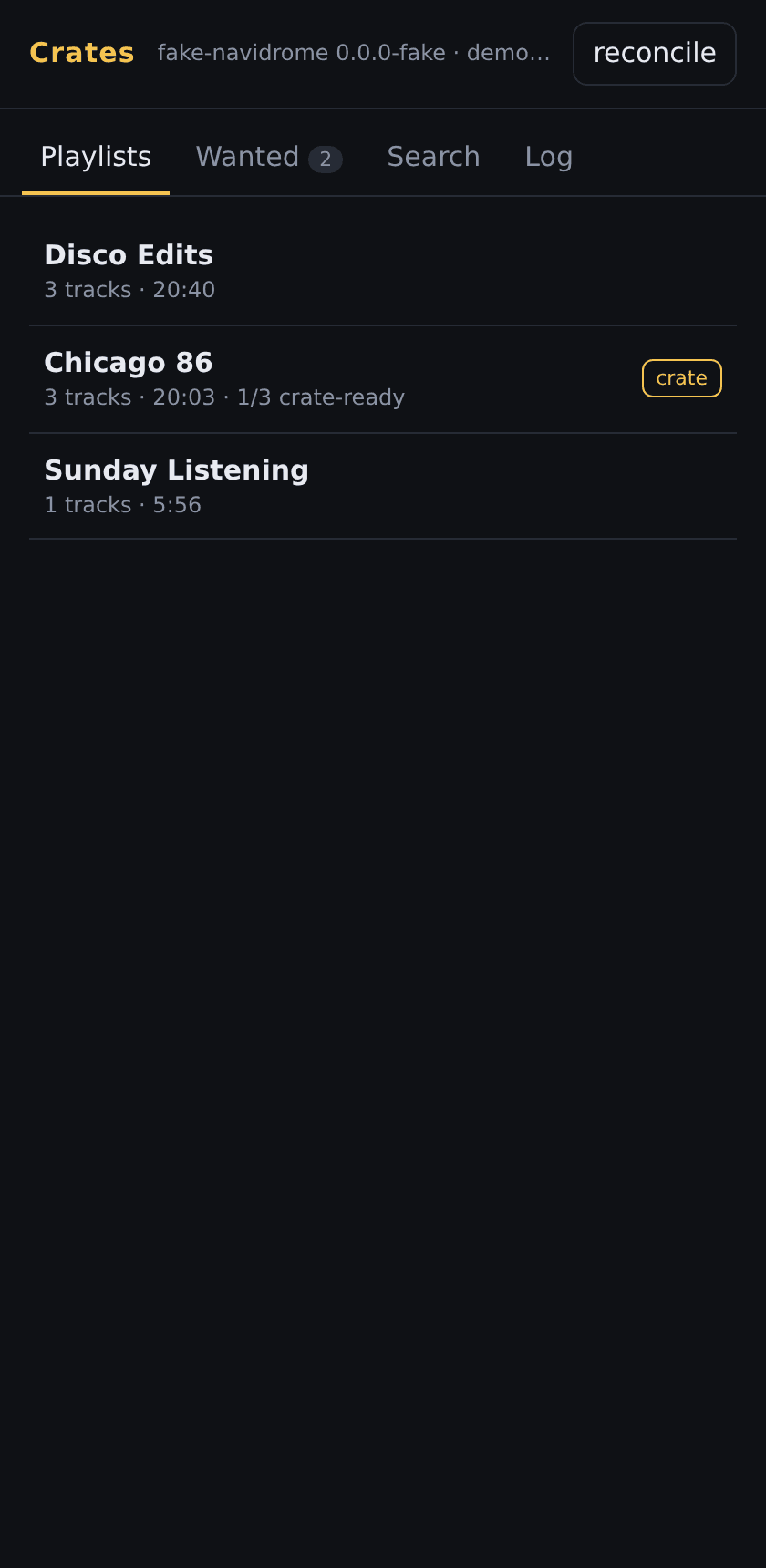
A music library I host at home and stream to my phone, with a crate pipeline that checks each file's real quality and never deletes from the library.
Designer and operator · Sep – Oct 2026
- songs, self-hosted, identical copies removed
- 831
- playlist entries kept intact through the retag and dedupe
- 1,405
- tests, all offline against fakes
- 1,359
- code never deletes a library file; every removal is a reversible move
- Trash, not delete
The Problem
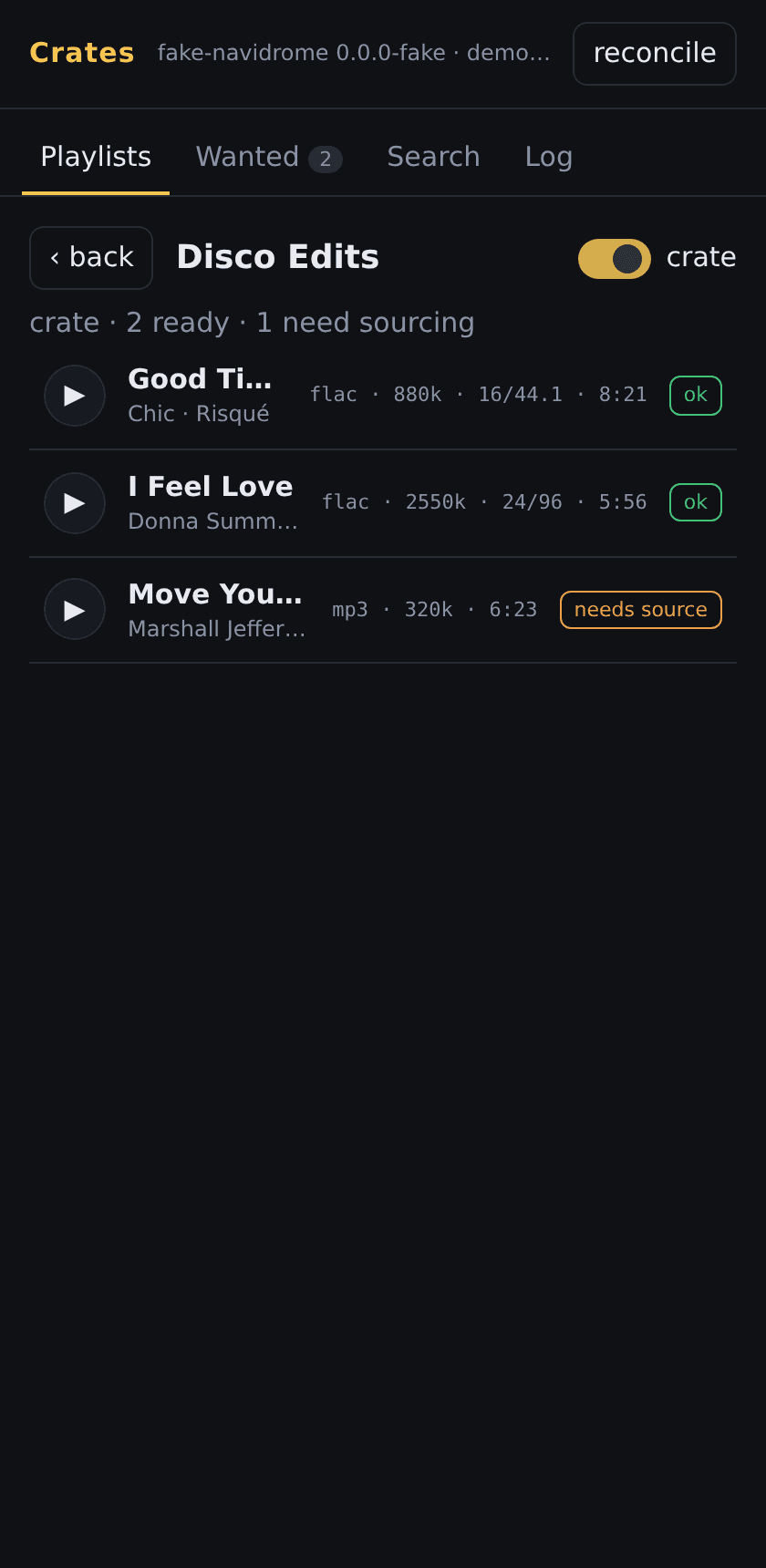
I wanted to stop depending on Spotify and stream my own music library from a box at home to my phone. I also wanted to flip any playlist into a DJ crate, where every track gets a DJ-quality file that is found, verified and filed automatically. And all of it had to be safe to run unattended on the one server that holds my only organised library.
Listening
Home server · Docker Compose
Every night
The Method
Diagnose
My music was about 22 GB of files with no good way to play it away from home. After the first night live, the counts matched while 92 titles were still wrong on my phone, 28 files were second copies of the same audio, and nothing could yet tell a real lossless file from one upscaled from a low-bitrate mp3.
Decide
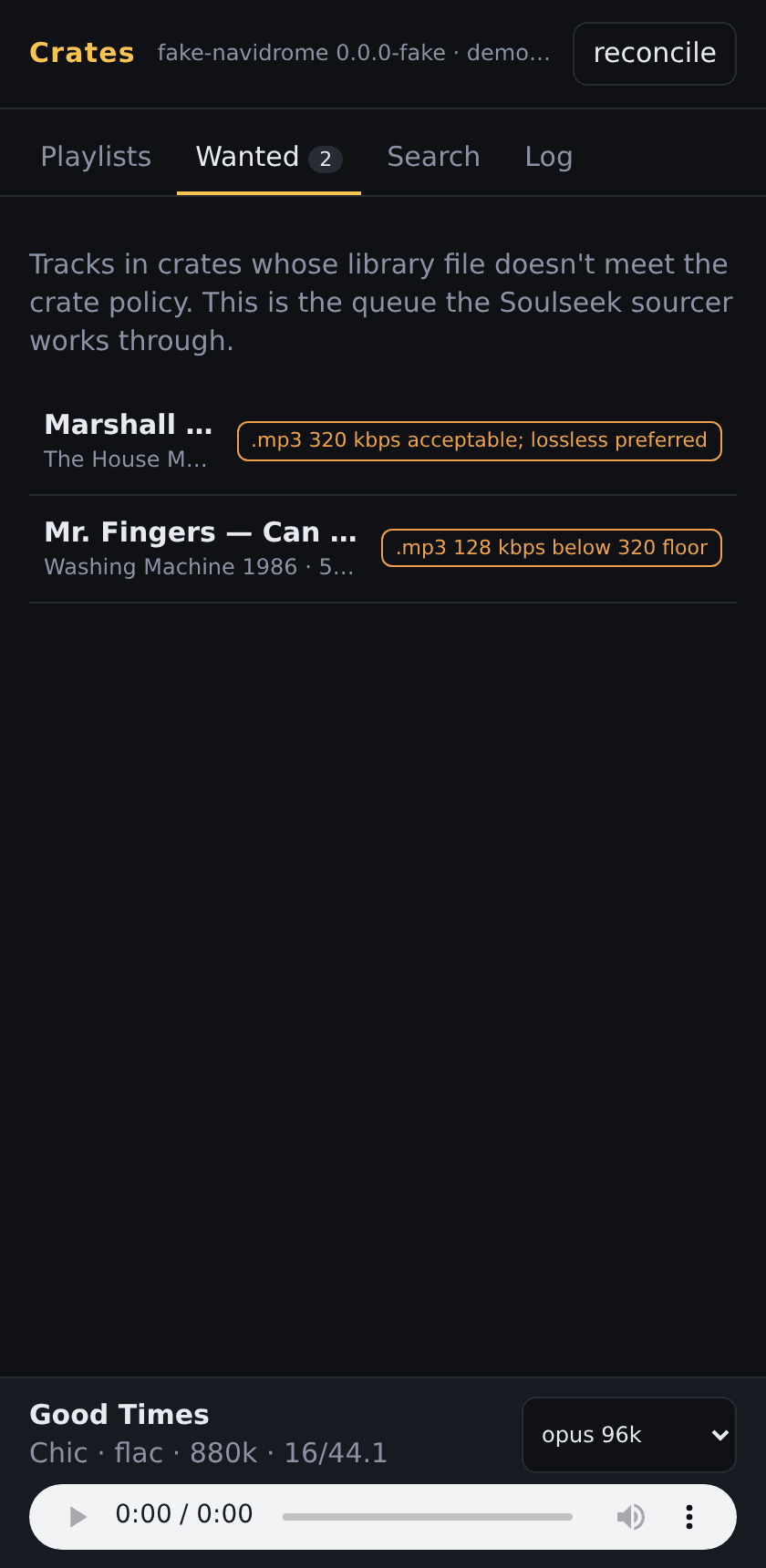
Navidrome owns the songs and playlists. A small crates service owns only the crate flags, the wanted queue and approvals, in its own SQLite database, and a stream is a redirect to Navidrome, so audio never passes through it. Downloads run in their own worker container, and nothing downloads until I have approved the first one by hand.
Build
I built it offline first, against a fake Navidrome, then took it live on Oct 13. Next came playlist import from Spotify, tag cleanup, dedupe, download validation, and a worker that searches a peer-to-peer network, Soulseek, through a VPN, verifies each file and files it with beets.
Verify
Every download is checked by one decode for the spectral cutoff, the bits actually used, truncation, silence and clipping, plus flac -t, and by an acoustic fingerprint when it replaces a library copy. The same check ran over the whole library in about 75 minutes, 6 files at a time. The 1,359 tests run offline against fakes built from captured live responses, and each milestone ends with me looking at the phone, not the counts.
Simplify
After using it, I replaced four quality tiers with one rule, lossless or 256 kbps and up, and left streaming quality to Navidrome and the phone app. "Prefer the 12-inch mix" became "source the exact track", the crate flag moved out of playlist comments into the app, and I deleted 35 cluttered playlists and kept 10; every one can be restored.
Key Decisions
- D7
The first real download is mine
Chose no automatic downloads until I had approved one by hand and said go, over letting the queue download on its own from day one because the chain from download to library had only run in tests, so its first real run should be one file I watch.
Cost: As of Oct 17 the download path had not run live: copy replacement and play-now wait on that first approval.
- D3
Duplicates go to the trash, not away
Chose moving each second copy to a dated trash folder with a logged reverse move, and repointing its playlists, over deleting duplicates because a wrong call should be one move from undone, and these 28 were copies that decoded to identical audio.
Cost: Code never empties the trash; it grows until I empty it by hand, and a status command reports its size and age.
- D24
One download quality
Chose one rule, lossless or lossy at 256 kbps or more, with streaming quality left to Navidrome and the phone app, over the four quality tiers I had built and tested because a downloaded file is kept for years and every stream is transcoded from it, so that one file's quality is the only one that matters.
Cost: The tier work became four tier names with the same rule in a config file.
- D27
The app owns the crate flag
Chose keeping which playlists are crates in the crates app's own database over a #crate tag written into each playlist's comment because playlist names and comments stay clean in every app that shows them, and one place holds the answer.
- D18
Downloads run in their own container
Chose a separate worker container that has no open port and handles only approved downloads, over running downloads from a script on the host because the web-facing service keeps a read-only view of the library, and credentials stay inside the containers.
- D38/39
A green backup means a fresh backup
Chose all-or-nothing database snapshots, and a nightly backup that fails when a snapshot fails, over refreshing each snapshot on its own and logging a warning because the monitoring heartbeat should be green only when the backup really holds fresh copies of both databases.
Cost: A broken snapshot turns the whole night red, even though the music itself was backed up.
How It Evolved
Sep 17–18 · Offline prototype
A candidate scorer, the crate layer, a fake Navidrome and a web client, all tested offline: 37 tests.
I wanted the design proven against fakes before it touched the real library.
Oct 13 · Live, night one
The stack went live: 917 original files became 859 tracks in 35 genre playlists, with the nightly backup job already running. Tests went from 37 to 80.
Every count matched, but my phone still showed 92 wrong titles.
Oct 13–15 · Library hygiene
Playlist import from Spotify, tag cleanup, dedupe, quality tiers and download validation; tests reached 249.
Downloads needed a place that could write to the library while the web-facing service stayed read-only.
Oct 15–16 · Worker + identity
A worker container that files downloads with beets, a model of songs, versions and copies, copy replacement and play-now; about 1,100 tests by the end.
After using it, the tiers and the version rules were more machinery than the job needed.
Oct 17 · The simplification
One download quality, the exact track, the app owns the crate flag. An overnight run of my agent harness then built duplicate-cleanup tooling, health checks and lock-protected backups: 1,359 tests.
The current version. The first real download waits for my go.
What Broke
What broke A guessed fake hid 3 critical bugs in the download client: the tests passed against a fake written from a guess at the API.
The rule Fakes mirror the live API: they are built from captured real responses.
What broke After the first night every count matched, 859 = 859 = 859, while 92 titles were still wrong on my phone.
The rule Every milestone ends by looking at the screen itself, not the counts. This site's build ends its milestones the same way.
What broke beets rewrote every tag on the live library and collapsed multi-valued genres. Review caught it, and the genres were repaired from the original files.
The rule No tool rewrites the whole library. beets writes full tags only on a fresh download with a confident MusicBrainz match.
What broke On Oct 15 the dedupe moved copies into trash paths where an earlier repair had kept damaged copies, and 18 of them were overwritten.
The rule The trash never overwrites: a name that is already there gets a numbered suffix.
What broke Verification would have thrown away good files: embedded webp cover art makes ffmpeg print "[error]" lines about audio that is fine.
The rule For FLAC, flac -t decides. A few ffmpeg complaints are a warning; only 10 or more, audio that won't decode, or digital silence fail.
What broke beets matched a 412 s 12-inch mix to a 403 s 90s mix.
The rule The id backfill doesn't use beets' matching: it proposes ids, I review them, and every apply can be reverted.
What broke Backups of the app's SQLite database were inconsistent: the main file was 4 KB and the data sat in the -wal file beside it.
The rule Databases are copied only with sqlite3 .backup. The new nightly job also takes the lock first; it is built and waits for my one-time install.
Outcome
Since Oct 13 the library has run on a desktop at home: 831 songs, about 22 GB, streamed to my phone over a private network and backed up every night, encrypted, to a second disk. The cleanup retagged 376 files, moved 359 out of "Compilations" and trashed 28 duplicates, and all 1,405 playlist entries came through intact. A check of the whole library found 22 of 831 files that fail the crate check, 17 of them upscaled from ~128 kbps sources: that is the upgrade list. MusicBrainz ids for 485 files are ready to apply, and 16 went in as a reversible trial. As of Oct 17 the download path had run only in tests; the first real download is mine to start.
In the Code
BAD  incoming/…/03 - Good Times.flac  (tier crate)
     flac 44100 Hz / 16 bit / 2 ch / 501.0 s  [flac-streaminfo]
     · cutoff ≈16 kHz
     · band dB vs full: >11k -24.8  >13k -26.7  >15k -30.4  >16k -35.0  >17k -82.7  >18k -84.7 …
     · decoded 501.0 s · bits used 16 · peak -9.31 dBFS · flat factor 0.0
     ✗ cutoff ≈16 kHz (energy stops above 16 kHz) for a lossless file: lossless or 320 kbps reaches 19–20 kHz, so this likely came from ≤128 kbps
A Closer Look
How it was builtI designed the system, set the specs, decided or approved every entry in the decision log, and decided every change to the live library. Claude Code agents wrote much of the code under that direction; the Oct 17 work was an overnight run of my agent harness.